
Cloudflare Pages vs Vercel: Choosing Your Edge Network
An in-depth comparison of Cloudflare Pages and Vercel for deploying high-performance static HTML builds.

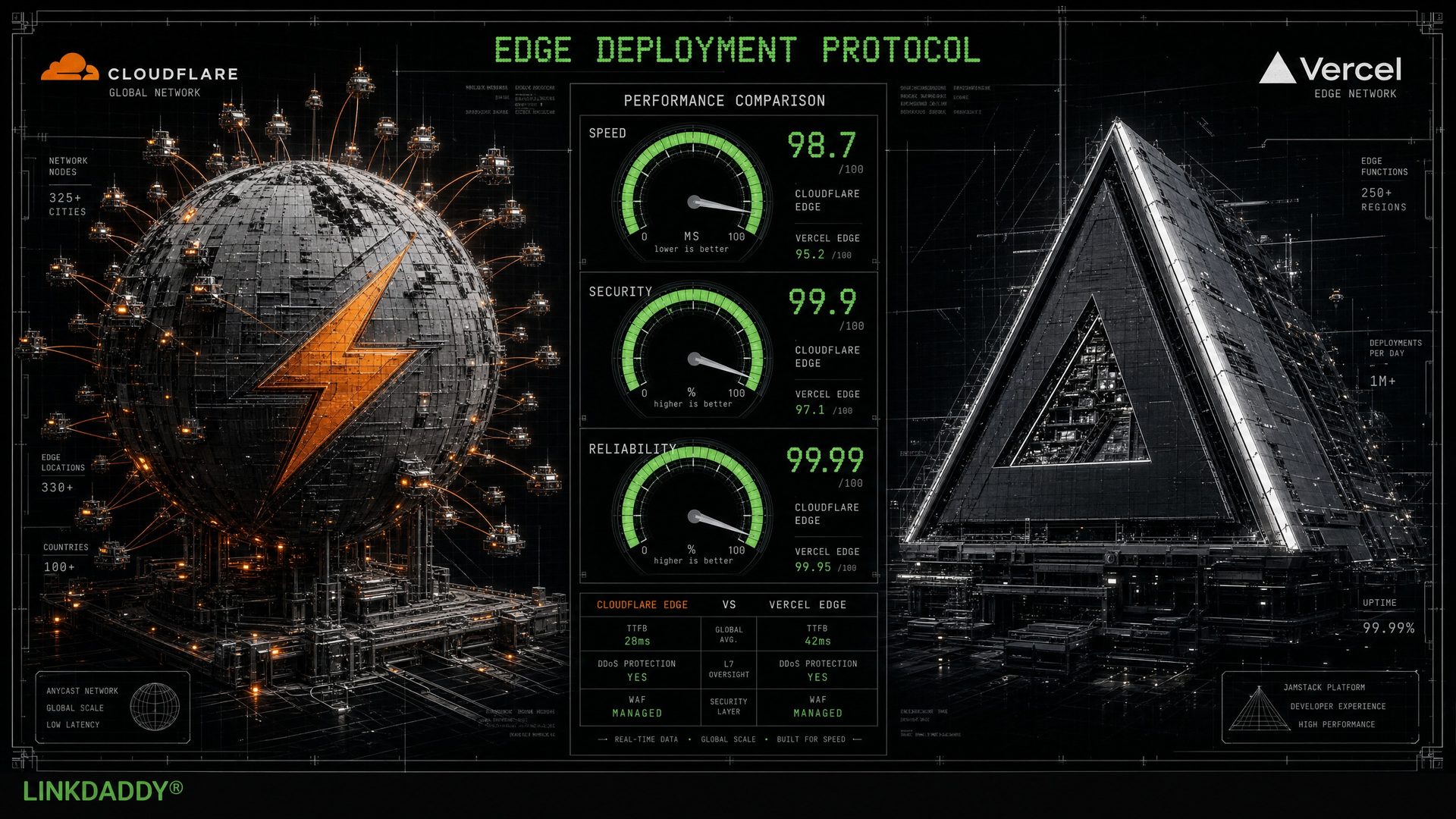
The Battle for the Edge: Moving Beyond the Server
When deploying a Sovereign HTML Build, the hosting environment is just as critical as the code itself. In the legacy web era, you rented a single server (or a cluster of servers) in a specific geographic location. If your server was in New York, a user in Tokyo experienced latency. Today, you are no longer renting a server; you are deploying to a global edge network.
An edge network distributes your static HTML files to hundreds of data centers worldwide. When a user requests your site, it is served from the node physically closest to them, resulting in sub-500ms load times globally. The two dominant players in this space are Cloudflare Pages vs Vercel.
Both platforms offer exceptional performance, seamless Git integration (push to deploy), and robust serverless functions. However, their underlying philosophies, infrastructure architectures, and pricing models differ significantly. Choosing the right one is a critical decision for your digital sovereignty.
Vercel: The Developer Experience Champion
Vercel is the creator and maintainer of Next.js, the React framework we use for our Sovereign HTML Builds. Unsurprisingly, if you are building a Next.js application, Vercel offers the most frictionless deployment experience possible. It is the "Apple ecosystem" of web deployment.
Features like native Image Optimization, Edge Middleware, Server-Side Rendering (SSR), and instant rollbacks work flawlessly out of the box with zero configuration. Vercel abstracts away the complexity of AWS (which powers much of their backend) and provides a beautiful, intuitive dashboard.
The Catch: The "Success Penalty"
However, Vercel's pricing model can become punitive at scale. They charge significantly for bandwidth overages, serverless function execution time, and image optimization requests. If your site goes viral or experiences a DDoS attack, you can be hit with a massive, unexpected bill. We call this the "Success Penalty." While excellent for prototyping and small sites, the economics break down for high-traffic enterprise assets.
Cloudflare Pages: The Infrastructure Powerhouse
Cloudflare approaches edge deployment from an infrastructure-first perspective. They are, fundamentally, a security and networking company that routes a significant percentage of the world's internet traffic. Cloudflare Pages leverages this massive global network (spanning over 300 cities).
The Sovereign Advantage: Unmetered Bandwidth
The most significant advantage of Cloudflare Pages is its pricing model. Cloudflare offers unmetered bandwidth. Whether you serve 10 gigabytes or 10 terabytes of static HTML, your cost remains the same. This provides absolute financial predictability.
Furthermore, Cloudflare's native security features—including their enterprise-grade Web Application Firewall (WAF) and automated DDoS mitigation—are integrated at the network level. For Sovereign HTML Builds adhering to the FIF Protocol, Cloudflare Pages is the superior choice. It provides the structural integrity and cost-certainty required for permanent digital assets.
Feature Comparison: Vercel vs Cloudflare Pages
To make an informed decision, we must look at the technical specifications and how they align with the goals of a Sovereign HTML Build.
| Technical Feature | Vercel | Cloudflare Pages |
|---|---|---|
| Next.js Integration | Native (Perfect). Supports all Next.js features immediately upon release. | Excellent. Requires the `@cloudflare/next-on-pages` adapter for edge rendering, but static exports are flawless. |
| Bandwidth Pricing | Metered. High overage costs ($40/100GB on Pro plan). Vulnerable to DDoS billing spikes. | Unmetered. Free bandwidth regardless of traffic volume. Absolute cost predictability. |
| Security Infrastructure | Standard protection. Advanced WAF requires Enterprise tier. | Enterprise-grade by default. Native WAF, bot management, and unmetered DDoS mitigation included. |
| Edge Network Size | Large (powered primarily by AWS infrastructure). | Massive. Cloudflare's proprietary network spans 300+ cities in 100+ countries. |
| Serverless Functions | Vercel Functions (Node.js/Edge). Easy to write, but execution time is metered and billed. | Cloudflare Workers (V8 Isolate). Extremely fast cold starts, generous free tier (100k requests/day). |
While Vercel wins on pure developer experience for Next.js, Cloudflare Pages wins decisively on infrastructure economics and security. For a business asset designed to last, Cloudflare is the superior foundation.
The FIF Protocol on Cloudflare Pages
At LinkDaddy, we deploy our Sovereign HTML Builds exclusively on Cloudflare Pages because it aligns perfectly with the Foundation, Infrastructure, Fortress (FIF) Protocol. The FIF Protocol requires absolute control over the digital asset, and Cloudflare provides the necessary tools to enforce this control at the network edge.
Here is how Cloudflare Pages specifically enables the FIF Protocol:
1. Edge-Level Redirects
When migrating a site, preserving link equity is paramount. Cloudflare allows us to execute 301 redirects at the edge node before the request ever hits the origin server. This ensures zero latency during the redirect process, preserving maximum PageRank.
2. Header Manipulation
We use Cloudflare Transform Rules to inject strict security headers (like Content Security Policy and HSTS) directly into the HTTP response. This hardens the asset against XSS attacks and ensures compliance with enterprise security standards.
3. Bot Management
Cloudflare's native bot management allows us to block malicious scrapers and spam bots while explicitly whitelisting the crawlers for Googlebot, Bingbot, and AI Answer Engines (like ChatGPT-User). This ensures our server resources are only spent on entities that matter.
The Economics of Scale
When building enterprise infrastructure, you must model costs at scale. A site that receives 10,000 visitors a month might cost $20 on Vercel. But what happens when a PR campaign hits, and that site receives 1,000,000 visitors in a week?
On Vercel, that traffic spike could result in a bandwidth overage bill of hundreds or even thousands of dollars. On Cloudflare Pages, the bill remains exactly the same. This unmetered bandwidth model allows agencies and enterprises to scale aggressively without fear of financial penalty.
R2 Object Storage Integration
Modern websites require heavy media assets—high-resolution images, videos, and PDFs. Hosting these directly in your Git repository slows down build times and clutters your codebase.
Cloudflare's R2 Object Storage integrates seamlessly with Cloudflare Pages. Unlike AWS S3, which charges exorbitant egress fees (the cost to move data out of their network), R2 has zero egress fees. This allows us to host massive media libraries—such as our forensically hardened Blueprint Brutalism images—without incurring the bandwidth costs associated with Vercel or AWS.
The Verdict: Sovereignty vs. Convenience
If you are a solo developer building a personal project or a startup prioritizing rapid iteration over long-term infrastructure costs, Vercel is an incredible platform. The developer experience is unmatched.
However, if you are an enterprise business or an agency building permanent digital assets for clients, Cloudflare Pages is the clear winner. It provides the unmetered bandwidth, enterprise-grade security, and granular network control required to execute the FIF Protocol and build true digital sovereignty.
Vendor Lock-in Considerations
A core tenet of digital sovereignty is avoiding vendor lock-in. While both platforms host Next.js applications, Vercel has increasingly introduced proprietary features (like specific caching mechanisms and edge functions) that only work on their infrastructure. If you heavily utilize these Vercel-specific features, migrating away becomes difficult.
By sticking to standard Next.js static exports (SSG) and deploying on Cloudflare Pages, you maintain maximum portability. Your HTML files are just HTML files. If Cloudflare ever changes their pricing or policies, you can move those files to AWS S3, Google Cloud Storage, or even a traditional Nginx server in minutes.
The Environmental Impact of Edge Computing
Beyond performance and economics, the choice of edge network has environmental implications. Traditional server hosting requires constant energy consumption to keep machines running, even when traffic is low.
Cloudflare has made significant commitments to sustainability, aiming to power its entire network with 100% renewable energy. By deploying Sovereign HTML Builds to Cloudflare Pages, you are not only securing your digital infrastructure but also participating in a more energy-efficient model of web hosting. The static nature of the files means compute resources are only used during the build process, drastically reducing the carbon footprint of your enterprise asset.
The Importance of Analytics and Observability
When operating at the edge, traditional analytics tools (like Google Analytics) can sometimes miss data due to ad blockers or strict privacy settings. Both Vercel and Cloudflare offer native edge analytics that capture 100% of requests directly at the network level.
Cloudflare Web Analytics provides comprehensive, privacy-first insights without requiring any client-side JavaScript. This means you get accurate traffic data, performance metrics, and security event logs without slowing down your Sovereign HTML Build or compromising user privacy. This level of observability is crucial for monitoring the health and growth of your digital asset.
Frequently Asked Questions
Which platform is faster?
For purely static HTML, performance is nearly identical. Both serve content from edge nodes globally, resulting in sub-500ms load times.
Can I migrate from Vercel to Cloudflare?
Yes. Because the underlying code is standard Next.js/React, migrating between edge providers is a straightforward process.
Do both support custom domains and SSL?
Yes. Both platforms provide free, automated SSL certificates and easy custom domain management.
Which is better for a Sovereign Build?
We generally recommend Cloudflare Pages for Sovereign Builds due to its unmetered bandwidth and superior security infrastructure, aligning perfectly with the FIF Protocol.
Are serverless functions supported?
Yes. Vercel uses Serverless/Edge Functions, while Cloudflare uses Cloudflare Workers. Both allow you to add dynamic functionality to your static site.
Deploy with Confidence
We build and deploy Sovereign HTML infrastructure optimized for the edge.
View Our Infrastructure